
What is Mohs Surgery?
Developed in the 1930s by Dr. Frederic Mohs, Mohs micrographic surgery has been refined into the most advanced, precise, and effective treatment for an increasing variety of skin cancer types. With the Mohs technique, physicians can precisely identify and remove an entire tumor while leaving the surrounding healthy tissue intact and unharmed. Mohs surgery is the most effective treatment for skin cancer.
How does Mohs Surgery work?
The Mohs procedure involves surgically removing skin cancer layer by layer and examining the tissue under a microscope until healthy, cancer-free tissue around the tumor is reached (called clear margins). Mohs surgery is unique and so effective because of the way the removed tissue is microscopically examined, evaluating 100% of the surgical margins. Because the ACMS surgeon is specially trained as a cancer surgeon, pathologist, and reconstructive surgeon, Mohs surgery has the highest success rate of all treatments for skin cancer – up to 99%.
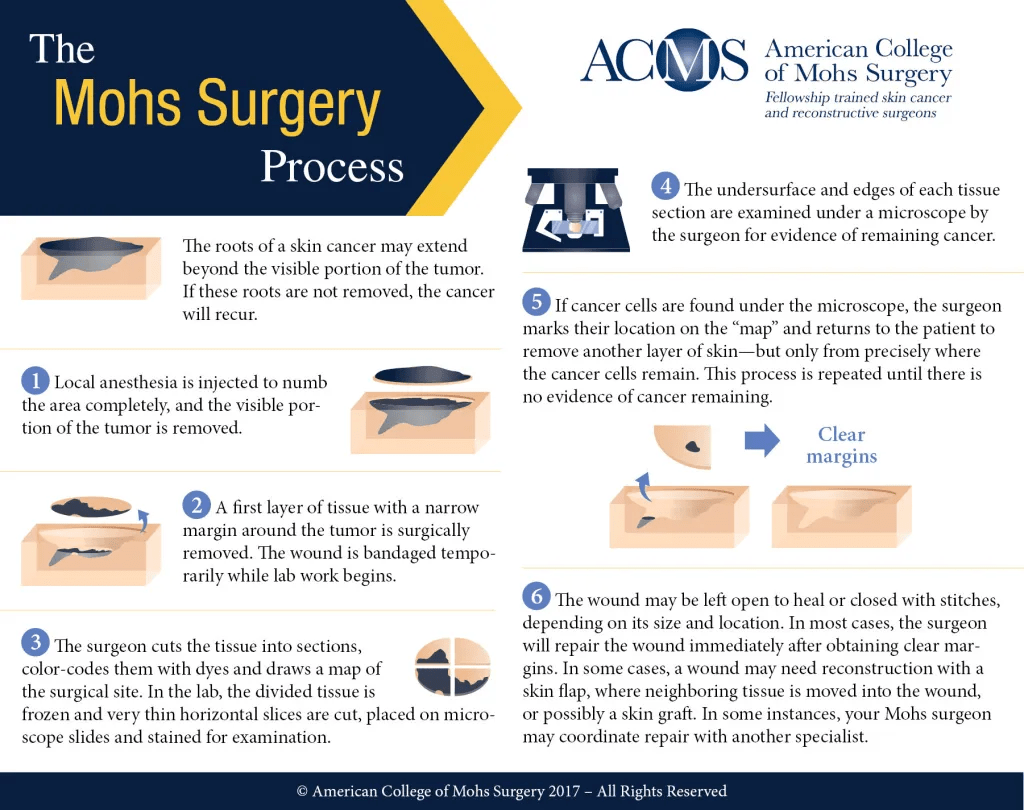
A Mohs surgeon is a board-certified dermatologist that has successfully completed a 1-2 year ACGME approved subspecialty fellowship with intense training in skin cancer surgery and management, skin pathology, and dermatologic reconstructive surgery. The American College of Mohs Surgery (ACMS) is a membership organization of more than 1,400 fellowship trained skin cancer and reconstructive surgeons specializing in the Mohs micrographic surgical technique used to treat skin cancer. The ACMS is the only organization that requires its members to have successfully completed an extensive one- to two-year fellowship training program in Mohs micrographic surgery after they have completed their years of dermatology residency training.
What are the advantages of Mohs surgery over other skin cancer treatment modalities?
- Ensuring complete cancer removal during surgery, virtually eliminating the chance of the cancer growing back
- Minimizing the amount of healthy tissue lost
- Maximizing the functional and cosmetic outcome resulting from surgery
- Repairing the site of the cancer the same day the cancer is removed, in most cases
- Curing skin cancer when other methods have failed
- Other skin cancer treatment methods blindly estimate the amount of tissue to treat, which can result in the unnecessary removal of healthy skin tissue and tumor re-growth if any cancer is missed.
Frequently Asked Questions:
Q: What is taking so long between layers?
A: Processing the tissue layers in our on-site lab takes between 1-2 hours depending on the size and cancer type.
Q: How do I take care of the wound site?
A: You will be provided with wound care instructions specific to your wound and repair type.
Q: Are there activity restraints after surgery?
A: It is recommended that you should avoid strenuous activity for 1-2 weeks after surgery.
Q: Do I need to stop my blood thinners before surgery?
A: No, the potential risks of stopping your blood thinner outweighs the small risk of bleeding from Mohs surgery.
Q: Will I have a scar?
A: Yes, any surgical treatment for skin cancer will leave a scar. Mohs surgery helps to spare as much healthy tissue as possible, thus leaving the smallest wound and maximizing the long term aesthetic outcome.
*This information was taken from the American College of Mohs Surgeons
Patient Education Resources:
 Dermatica
Leave a Reply